Viggo Dürer
Crow GirlViggo Dürer is the assumed male identity of Gilah Berkowitz, whose late revelation changes the meaning of her role as lawyer, benefactor, and associate of powerful men. The novel first presents Dürer through other people’s accounts and scattered clues: a lawyer named in Linnea Lundström’s drawings, a former sawmill worker connected to a northern religious movement, and a benefactor said to have brought children to Sweden. Only near the end does the name resolve into a disguise, exposing a life shaped by concealment and the control of other people’s identities.
Identity and Public Career
Dürer’s professional authority proves difficult to verify. In the late 1960s, she appears in Vuollerim as an accountant at a sawmill, not as a lawyer. When investigators look into her background, they find no evidence of formal legal qualifications, examinations, or a degree. The absence of documentation does not by itself establish how she acquired the position, but it makes the confidence attached to her professional title conspicuous. For years, apparently, nobody checked her credentials.
Before settling into that later public role, Dürer worked at a sawmill and spoke to a newspaper during a controversy around the Korpela movement. In the interview she defended the Lundström family and dismissed the Psalms of the Lamb as a journalistic invention. The article places her within the events without showing her as one of the people named in a police complaint. A later account suggests she may already have been ambitious for public notice, though that remains an interpretation rather than a demonstrated motive. Her early appearance in print thus offers a small but significant contrast with the obscurity that surrounds her qualifications and past.
Dürer’s northern history is tied to Polcirkeln, where a sect with branches across northern Lapland and Norrbotten was reported to have its headquarters. The story faded from public attention, while Karl Lundström and Annette Lundström moved south and eventually married. Dürer’s presence in one of the old articles gives investigators a documentary thread connecting her to the family before the later disclosures about their shared history. It also places the character at the intersection of public rumor and private influence: visible enough to speak to a newspaper, yet still difficult to pin down.
Children, the Lundström Family, and the Foundation
Linnea Lundström identifies Dürer as her father’s lawyer. She has drawn Dürer repeatedly, and Sofia Zetterlund begins to recognize the name as more than a detail in the girl’s pictures. When Sofia asks about the figure in a drawing, Linnea says she has never felt understood by anyone else in relation to her drawings. The revelation makes Dürer a point of contact between Linnea’s private distress and the wider investigation; it does not, on its own, establish everything the drawings imply.
Annette Lundström later describes Dürer as one of the men who led the faithful in the northern group, alongside Karl and Per-Ola Silfverberg. In her account, Dürer and Per-Ola handled practical matters, while the children were included among the initiated. Annette names Linnea, Madeleine Silfverberg, and children who had been adopted. She says that Dürer helped children arrive in Sweden from difficult circumstances abroad, where they sometimes stayed on the farm for days or months before he found them new families. She presents this arrangement as benevolent and describes the children as having what they needed. Her account also connects the household to a teaching called the word of Pythia.
Annette’s testimony requires caution: she is confused about time and space, and Jens Hurtig does not yet know whether her worldview is reliable or the product of psychosis. Even so, her statements give the investigators a pattern to compare with other evidence. Hurtig recognizes connections in what she says and identifies Sihtunum i Diasporan as a foundation involving Dürer, Karl Lundström, and Bengt Bergman. Annette describes the foundation in favorable terms, as aid to poor people abroad and a route by which adopted children could live in Sweden. She says Bengt helped fund it, although she had never met him herself. The charitable account and the group’s secrecy remain in tension; the text presents them together without treating Annette’s account as a complete or independently verified history.
Relationships and the Pattern of Control
Dürer’s ties to the Lundström household extend beyond a professional relationship with Karl. Annette tells Sofia that Dürer gave her money and suggested that Linnea did not need to see more psychologists. Annette welcomes the money and imagines using it to return to Polcirkeln and build a temple. The exchange reveals the practical reach Dürer has retained in the family’s life, while Annette’s response shows how her own religious framework shapes what she makes of that support.
Victoria Bergman’s reflections connect Dürer to Madeleine and to the recurring pattern of people claiming authority over others. Victoria writes that Madeleine had a special relationship with Dürer, then considers that Dürer was the kind of person who laid claim to people. She links this pattern to Dürer’s conduct toward both Annette and Linnea, and to an attempt to establish the same kind of hold over herself. Victoria’s account places Dürer in a chain of relationships rather than treating each one as isolated: attention and apparent help can become means of possession and control. Her recognition is retrospective, and the pattern she identifies gives the earlier reports of Dürer’s involvement with children a more troubling significance.
Victoria also describes Dürer’s role in the circumstances surrounding the loss of her baby. She says Dürer arranged a system of documents that included a declaration of her legal incompetence in Sweden, power of attorney for Bengt, and conflicting records of the baby’s birth date. The paperwork, in her account, was structured to defeat any challenge she might make: one document could be used to answer another, while the official records represented her as underage and mentally incompetent. Her testimony makes Dürer’s influence legible not only through personal relationships but through legal and medical institutions. The papers function as instruments that can override her account of her own life.
Exposure, Death, and Narrative Significance
Dürer’s name enters the investigation through several routes. Sofia recalls that Linnea has mentioned the lawyer more than once and regrets raising the name when she does so. An earlier memory gives the possibility of direct violence a different shape: Sofia remembers holding a bolt gun and realizing that she could have killed Dürer. She did not, and the narrative marks the counterfactual plainly: had she acted, Linnea’s story would have been different. This memory does not resolve the case, but it emphasizes how Dürer’s presence has drawn others toward irreversible choices.
A separate recollection by prosecutor Kenneth von Kwist shows Dürer at a summer cottage on Möja with former police commissioner Gert Berglind and an unidentified Ukrainian associate. When Dürer and Berglind quarrel, Dürer remains silent for a time, then speaks quietly to the Ukrainian in Russian. The man leaves the kitchen and goes to the enclosure where Berglind keeps prizewinning rabbits. The episode suggests Dürer’s capacity to act through an associate while avoiding an overt instruction in front of the others. Von Kwist later acknowledges the contradiction in Dürer’s character: she could be dangerous, yet also appear weak and complain of heart problems. Her combination of authority and vulnerability frustrates his rigid division between right and wrong.
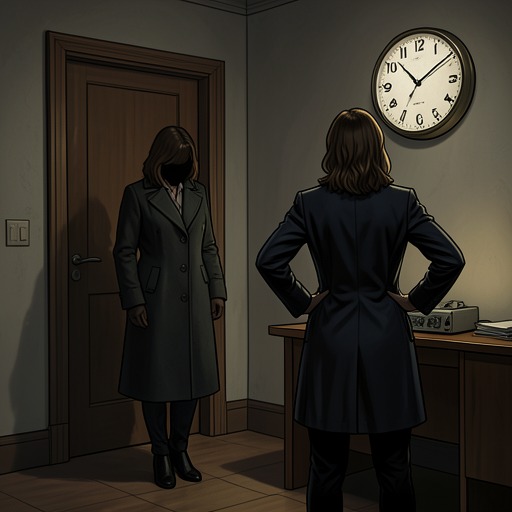
The final disclosure identifies Dürer as Gilah Berkowitz, an elderly woman whose assumed identity has obscured her history for decades. At a memorial marked by a menorah, she wears a coat bearing the sign of a liberated prisoner from Dachau. The coat, however, was intended for a young Dane named Viggo Dürer; it is not her own. The apparent sign of freedom therefore belongs to another person’s identity. Gilah understands herself as never having been free, either before or after Dachau, and returns to the memorial expecting to conclude her agreement with Madeleine and find peace with those she once sent to their deaths. The revelation recasts the name Dürer not merely as a false professional persona but as an identity assumed from another life.
The closing account confirms that Dürer has been found dead in a park in Kyiv, and the final scene depicts the elderly Gilah being shot at the memorial. The investigation is therefore closed in one sense, but Jeanette Kihlberg remains dissatisfied: she has not found Madeleine, and important questions about the murders and their connections remain unresolved. Dürer’s significance lies partly in this deliberate incompleteness. Her roles—as lawyer, advocate for children, religious organizer, and hidden perpetrator—cannot be cleanly reconciled, and the novel leaves the reader with the human cost of a life organized around borrowed names, institutional paperwork, and power exercised behind benevolent appearances.